In a typical heart:
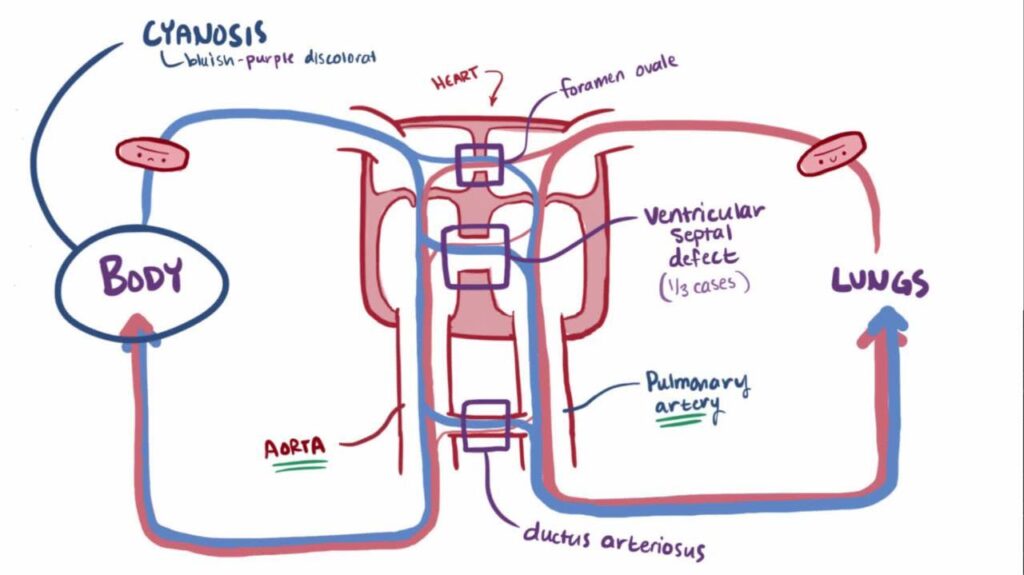
- The pulmonary artery carries oxygen-poor (blue) blood from the right ventricle to the lungs.
- The aorta carries oxygen-rich (red) blood from the left ventricle out to the body.
In TGA:
The aorta arises from the right ventricle instead of the left.
The pulmonary artery arises from the left ventricle instead of the right.
Because of this switch, oxygen-poor blood is sent out to the body and oxygen-rich blood goes back to the lungs rather than out to the body.
For survival before repair, there must be some mixing of the blood (via a ductus arteriosus, atrial/ventricular septal defect, etc.).
The usual repair is early in life via the Arterial Switch Operation (“Jatene” procedure) to correct the anatomy.
In simple parent-friendly language:
“TGA means that the two big arteries from the heart are switched. Because of that, the baby’s body doesn’t get enough oxygen unless the heart is fixed. It’s serious but treatable.”
Trusted source summary from the Mayo Clinic:
“Transposition of the great arteries … is a serious, rare heart condition in which the two main arteries leaving the heart are switched.”